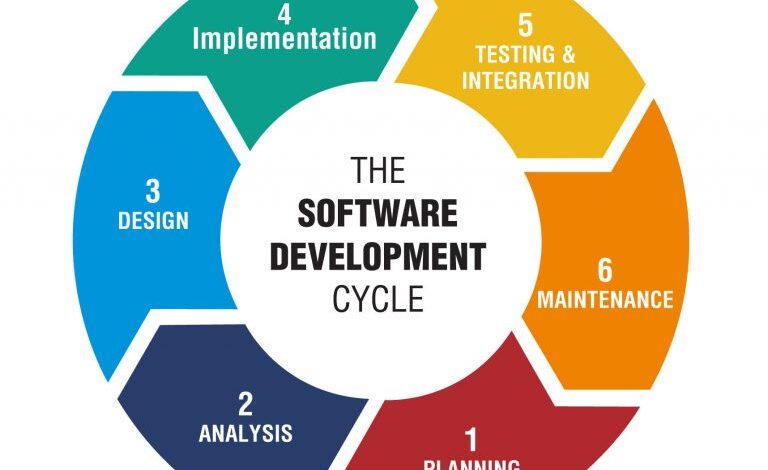
Software Development Life Cycle (SDLC) refers to a standard and organized process used to develop software. It provides a clear framework that guides software developers and teams in planning, designing, building, testing, and launching software step by step. By following this structured process, developers can ensure that the software is efficient, reliable, and high-performing. SDLC helps teams manage time, reduce errors, improve quality, and deliver software that meets users’ needs.
In general, everything in the world has a life cycle. For example, humans have a life cycle that includes stages such as birth, childhood, adulthood, and old age. Each stage plays an important role in shaping a person’s life. To become a successful and responsible person, an individual should follow a disciplined and well-organized lifestyle, which includes setting goals, managing time effectively, and maintaining healthy relationships. The process through which a person grows, learns, works, and develops throughout life is known as the human life cycle.
Similarly, every product, system, or object that is created also has its life cycle. It begins with an idea or concept, then moves through stages such as planning, development, testing, and finally release or use. In the same way, software development follows a life cycle known as the Software Development Life Cycle (SDLC). This life cycle ensures that software is developed in a systematic manner, from the initial idea to the final product used by customers.
Therefore, SDLC is essential for creating high-quality software. It provides a step-by-step method that helps developers think clearly, organize their work, and produce software that is useful, reliable, and performs well in real-world situations.
Software Development Life Cycle (SDLC)
Phase 1: Planning
The first phase of the Software Development Life Cycle is planning. This stage is the starting point of any software project. In this phase, developers, project managers, and stakeholders discuss the main idea of the software and determine its overall goals and objectives.
Software planning starts with defining the software’s purpose, its users, and the issues it will address. The development team also considers quality assurance requirements, budget, timeline, and available resources. During this phase, the team also identifies and analyzes risks, predicting potential problems or challenges in advance.
By creating a clear and well-structured plan, the development team can understand the entire scope of the project and prepare a roadmap for building the software successfully.
Phase 2: Requirement and Risk Analysis
The second phase is requirement and risk analysis. In this stage, developers collect and analyze all the requirements needed to build the software. Requirements describe what the software should do, how it should perform, and what features it must include.
Developers communicate with clients, stakeholders, or end users to understand their expectations and needs. The development team documents the collected information clearly, allowing them to follow it throughout the entire project.
At the same time, the team carefully analyzes possible technical risks, security risks, or performance issues that might occur during development. Understanding these risks early helps the team plan solutions and avoid major problems later.
Phase 3: Design
The design phase is crucial in SDLC because it dictates the software’s appearance and function. In this stage, developers convert the collected requirements into a software architecture and system design.
Design includes creating system structure, database models, interface layouts, and workflow diagrams. The design also focuses on user interface (UI) and user experience (UX) because these are the parts that users directly interact with.
Casual users can only see and interact with the visual design and interface of the software, but they cannot see the internal coding or development process. Therefore, a well-planned and user-friendly design is essential for making the software attractive, easy to use, and efficient.
Phase 4: Development (Implementation)
The development phase is the core stage of the software development process. In this phase, programmers start writing the actual source code based on the system design prepared in the previous stage.
Developers build all the features and functions of the software using programming languages, frameworks, and development tools. During this stage, they also ensure that the software properly manages user interaction, data processing, and system operations.
Developers may work in teams where each member is responsible for building specific modules or components of the software. Proper documentation is also created to help users understand how to use the system.
Phase 5: Testing and Integration
Once the development phase is completed, the software enters the testing and integration phase. In this stage, the entire system is carefully examined to ensure that it works correctly and meets all requirements.
Different types of testing are performed, such as unit testing, integration testing, system testing, and performance testing. The goal is to detect any errors, bugs, or missing features in the software.
Developers debug the code to fix any issues that arise. Missing functions can also be integrated at this stage. This process continues until the software becomes stable, reliable, and ready for real-world use.
Phase 6: Deployment and Maintenance
After successful testing, the software is ready for deployment, which means it is officially released to users. Sometimes the software is first released to a limited group of users or a specific business environment to observe how it performs in real situations.
This stage is often called beta testing or pilot release. If users report any problems or new requirements, developers update and improve the software accordingly.
The development team must continue maintenance even after launching the software, which involves fixing bugs, improving performance, adding new features, and ensuring security updates. Continuous maintenance ensures that the software remains useful and reliable for users over time.
The Software Development Life Cycle (SDLC) is a structured and systematic process used to develop high-quality software efficiently. It divides the entire development process into several important phases, such as planning, requirement analysis, design, development, testing, deployment, and maintenance. Each phase plays a vital role in ensuring that the software is built correctly and meets the needs of users.
By following the SDLC process, developers can organize their work properly, reduce risks, identify errors early, and improve the overall quality of the software. It also helps teams manage time, cost, and resources more effectively while delivering reliable and user-friendly applications.
SDLC is essential for successful software development because it provides a clear roadmap from the initial idea to the final product. With proper planning, careful design, thorough testing, and continuous maintenance, SDLC ensures that software remains efficient, secure, and useful for users over time.

Leave a Comment