
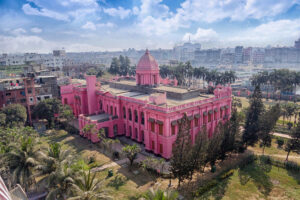
Ahsan Manzil is situated in Kumartoli on the banks of the Buriganga River in Dhaka, Bangladesh, where it stands as one of the city’s most iconic historical landmarks. It served as the official residence of the Nawab of Dhaka and was a prominent center of political, social, and cultural activities. The construction of Ahsan Manzil started in 1859 and was completed in 1869. It is built in the Indo-Saracenic Revival architectural style. It has been acknowledged as a national museum.
History
Sheikh Enayet Ullah, the landlord of Jamalpur Porgona (district), had a garden house in this place in the Mughal era. He was a very charming person. He included a very big area in Kumortuli (Kumartuli) in his garden house. He built a beautiful palace here named “Rongomohol” (Rangamahal). Here he kept beautiful girls from the country and abroad and used to enjoy time with them, dressing them in gorgeous dresses and ornaments.
It is said that the faujdar of Dhaka was attracted to one of the girls. He conspired and invited Sheikh Enayet Ullah to a party one night, killing him. That girl also committed suicide afterwards. In the northeast corner of the palace yard, there was the grave of Sheikh Enayet Ullah, which was ruined in the beginning of the 20th century.
Sheikh Moti Ullah, the son of Sheikh Enayet Ullah, sold the property to French traders around the 1740s. The trading house became wealthier after buying it. At that time, the French became very rich by trading here in comparison with the English and other European companies. In that purchased property, they built a big palace and dug a pond.
The pond is still there, which was called “Les Jalla” at that time. The French got defeated in the English-French war, and the English captured all their properties. French transferred the property to a French tradesman, Mr. Champigni, in 1785 and retook it in 1801. In 1827 the property was again returned to the French as they claimed all their left properties in Dhaka.
The French were forced to leave the subcontinent due to the increasing power of the English. They made the decision to sell their properties. In 1830, established landlord of Dhaka, Khwaja Alimullah, purchased the trading house of Kumartuli.
A stable and a family mosque were built in the compound at this time. After his death, his son Khwaja Abdul Ghani renamed the palace Ahsan Manzil in honor of his own son, Khwaja Ahsanullah. He did renovation work to the old building and also made a new building on the east side of the old building.
In the evening of April 7th, 1888, a devastating tornado hit Dhaka city, and Ahsan Manzil was severely damaged by it. After examining, an English engineer from Kolkata gave his opinion to reconstruct all the parts of the palace except “Rangamahal.” Then Khwaja Abdul Ghani and his son reconstructed the place with a new design.
The glory of Ahsan Manzil ended after the death of Khwaja Ahsanullah. Because of a family quarrel, his successors couldn’t continue the glory. Government acquired the property in 1952. In 1985, the Dhaka National Museum acquired the property and transformed it into a museum, preserving its historical and architectural significance for future generations.
Ahsan Manzil | An Architecture of The Mughal Period
Description
Ahsan Manzil is divided into two main sections: the eastern wing and the western wing, each featuring distinct architectural and functional characteristics. The eastern side is called the Rangamahal. The western side is called Andarmahal, and it has the living rooms. The octagonal dome is placed in the central room. There are also large drawing rooms, card rooms, a library, a state room, and other guest rooms. The ballroom, the Hindustani room, and residential rooms are located on the western side of the palace.
There is a beautiful vaulted artificial ceiling made of wood. The floors of the dining and Darbar Halls are decorated with white, green, and yellow ceramic tiles. There are attractive wooden stairs in the room. The wooden ceiling of the room is decorated with geometric designs. The verandas and rooms are covered with marble. The architecture and the decoration of Ahsan Manzil are very elegant.
Glory days and decay
Ahsan Manzil is an architectural treasure and has witnessed many historical events of Bangladesh. Ahsan Manzil played a significant role in the political history of East Bengal, serving as a gathering place where many influential Muslim leaders met and important political movements took shape. The Nawabs of Dhaka also used to conduct their court affairs here. When the Nawabs of Dhaka declined, Ahsan Manzil also started to decay. It became impossible to maintain the palace for the successors of the Nawabs. Without considering its dignity, the successors rented out rooms. It led the palace on the verge of collapse. The place turned into a filthy slum over the years. The palace was decided to be auctioned in 1974.
Renovation
The government of Bangladesh acknowledged the historical and architectural importance of Ahsan Manzil and decided to renovate it. The renovation was supervised under the Directorate of Public Works and Architecture. After the renovation work, it was brought under the control of the Bangladesh National Museum. A museum has also been established there.

Leave a Comment