
Hilsa is the national fish of Bengalis, not only in Bangladesh. It is a marine fish that comes from the Bay of Bengal to the rivers of Bangladesh and eastern India to lay eggs. It is very popular among Bengalis. It is also a very popular fish in various parts of India such as West Bengal, Orissa, Tripura, and Assam. In 2017, Bangladesh’s this fish was recognized as a geographical indicator, or GI, product. As a result, it gained international recognition in the economic field of Bangladesh.
Different names in different countries
The name Hilsa is commonly used in Bengali and Assamese, while in Telugu it is known as Pulasa or Polasa (పులస). In the Sindhi language of Pakistan, it is called Pallu Machhi (Sindhi: پلو مڇي Pallu Machhi); in Oriya, Ilishi (Oriya: ଇଲିଶି Ilishii); in Gujarat, Ilish fish is known as Moden (female) or Palva (male).
Area:
It is an economically important tropical fish. In the deltaic region of the Bay of Bengal, a large quantity of it is caught every year from the haors at the mouth of the Padma-Meghna-Jamuna River. Hilsa is a marine fish, but it migrates to large freshwater rivers to lay its eggs, making it an anadromous species.
When the eggs hatch and the baby grows up (called “jatka” in Bengali), the fish goes back to the sea. Fishermen typically catch this fish as it migrates back to the sea after spawning.
Although it is a saltwater fish or marine fish, it lives mostly in the sea but migrates to rivers in the Indian subcontinent over a distance of about 1200 km for breeding. In Bangladesh, the average width of major rivers generally ranges from about 50 meters to 100 meters, though some rivers are much wider depending on the season and location.
This is mainly found in abundance in the Padma (parts of the Ganges), Meghna (parts of the Brahmaputra), and Godavari rivers in Bangladesh. Among these, the taste of Padma is considered to be the best. This from the Rupnarayan River, Ganges, and Godavari River in India is famous for its delicious eggs. The fish is also caught from the sea, but the fish in the sea is not as tasty as the river fish. This fish is also found in Pakistan, particularly in the rivers and coastal waters of Sindh Province. There the fish is known as palla. This fish is also found in very small quantities in the Thatta district. At present, due to the falling water level of the Indus River, palla is no longer seen.
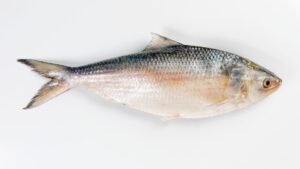
Hilsa is The King of fish in Bangladesh
Accommodation
It is a saltwater fish. It is usually found during the monsoons in canals connected to large rivers and estuaries. During the breeding season, these fish migrate from the sea to large rivers and estuaries, where they lay their eggs before returning to the ocean.
This fish cannot be cultivated. Fishermen take fishing boats to the river and cast their nets to catch fish. These fish are brought to the coastal pier. From there it is sent to distant parts of the country with ice. This fish is found more at the confluence of three rivers in the Chandpur district. Chandpur district is famous for it. Bangladesh also earns significant foreign exchange by exporting hilsa fish, making it an important contributor to the country’s economy.
Ingredients and recipes
This is a fatty fish, and it contains a lot of essential fatty acids (omega-3 fatty acids). Some recent studies in rats suggest that this acid may help lower cholesterol and insulin levels. However, more research is needed to confirm whether the same effects occur in humans.
Popular hilsa dishes include mustard hilsa, steamed hilsa, hilsa paturi, crispy fried hilsa, dopeyaza, and flavorful hilsa soup, all cherished for their rich taste and aroma.
Kachu leaves and hilsa fish cut, head, etc. is a special dish.
Egg-filled hilsa and aromatic rice are cooked together in a traditional dish known as Bhaturi, also called Hilsa Polao, which is celebrated for its rich flavor and unique preparation.
This is a traditional rainy-season delicacy, enjoyed for its rich flavor and seasonal freshness.
This fish can be preserved for many days by chopping it and salting it. It preserved in this way is called salty hilsa. Hilsa is also used to prepare a wide variety of delicious traditional and modern dishes, making it a favorite in many households.
In Bangladesh, this fish is steamed, fried, boiled, wrapped in young banana leaves and burnt, dried with mustard, cumin, eggplant, and pineapple and dried, and cooked in many different ways. It is said that there are about 50 different recipes for this fish. Hilsa eggs are a very popular food. This fish requires very little oil to cook because the fish contains a lot of oil. Because fresh hilsa is not always readily available in North America, many Bengalis use shad as a popular alternative due to its similar taste and texture.
White fish is considered an alternative to it because the color and taste of this fish are almost like this fish.
Different cultures
Many Bengali Hindu families buy a pair of hilsa or two fish on the auspicious day of various pujas. In Saraswati Puja and Lakshmi Puja, buying a pair of them is considered a very auspicious sign. But this practice is prevalent among the Bengali Hindus of West Bengal (India) and Bangladesh. Many of them offer this fish to Goddess Lakshmi. Many people think that worship is incomplete without offering it.
Economy of Bangladesh
At present, the country is producing 45 lakh tons of fish annually. About 12 percent of it is hilsa. That means more than 5 lakh tons of it.
According to the International Fisheries Research Organization, 75% of the world’s catch is harvested in Bangladesh. Of the remaining 25 percent, 15 percent are in Myanmar, 5 percent in India, and the remaining 5 percent in other countries. The Hilsa of Bangladesh is incomparable in taste and smell. Due to this, the demand for it in Bangladesh is high. But considering the demand of the country’s market, it is not being allowed to be exported abroad.
It contributes about 1 percent to the country’s GDP. That is 25 thousand crore taka. Earlier the amount was even less. Initiatives have been taken to increase the contribution of it to the GDP by increasing its production. About 2.5 million people are involved in fish procurement, transportation, marketing, and retail business. It is making a significant contribution to employment and poverty alleviation, especially in coastal islands and chars.

Leave a Comment